My passion has been art for as long as I can remember. With my art I strive for one main goal, and that is to stir the emotions from those who view it. I admire subtlety and believe that as much can be said through it as exaggeration. I love God, family, and friends, and they are, above all else, the most important things in my life.
Hans Fischerkoesen, was among the most distinguished animators remaining in Germany between 1933 and 1945, his work during the war years included a trio of remarkable films: Verwitterte Melodie (Weather-beaten Melody, 1942), Der Schneemann (The Snowman, 1943) and Das dumme Gänslein (The Silly Goose, 1944). In 1921 Fischerkoesen made a successful advertising film, Bummel-Petrus (Strolling Peter), for the Leipzig shoe factory Nordheimer, which led to a two-year contract with Julius Pinschewer, who had pioneered the use of animated commercials in movie theaters back in 1911. Afterwards, he established his Fischerkoesen Studio in Leipzig to specialize in advertising films, something Fischerkoesen seemed perfectly suited to. After all, he had an irrepressible sense of humor, a good sense of rhythm, and a charming, flexible cartoon style--as well as the obsessive concentration necessary to make animated films perfect in every way. He also had the knack for seeing a pun or twist in some old saying, common situation or popular song which would fit right in with a product. He philosophized about advertising, proposing the "if-then" formula (If you use this product, then this will happen; if you have this problem, then this product will help) as the best format for a succinct, cogent ad. Certainly, he received critical acclaim: by 1956, he had won major prizes at commercial film festivals in Rome, Milan (three times), Venice, Monte Carlo, and Cannes. He also appeared on the cover of the prestigious Der Spiegel, Germany's equivalent of the American Time magazine. Fischerkoesen continued to make advertising films until 1969, and died in 1973.
Here you can see an advertisement for "Underberg", an herbal digestive aid. The best advertisement ever.
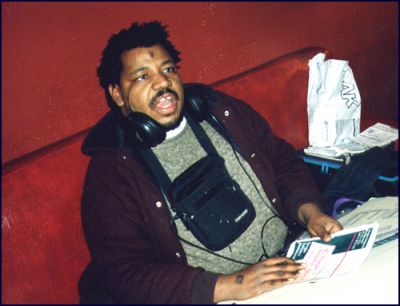
Wesley Willis (May 31, 1963 – August 21, 2003) was an African-American musician and artist from Chicago, Illinois as well as a diagnosed schizophrenic.
He gained a sizeable cult following in the 1990s after releasing several hundred songs of unique and simple music which became an internet phenomenon during the early days of P2P file sharing.
In 1989, Willis began hearing what he called "demon voices" and was diagnosed with schizophrenia. He often mentioned that his demons were named "Heartbreaker," "Nervewrecker," and "Meansucker". He called his psychotic episodes "hell rides". Alternatively, he declared rock and roll to be "the joy ride music" and Willis often indicated that listening to and performing music helped him battle the voices.
In the early 1990s, Willis became creatively active, selling magic marker drawings of the Chicago cityscape on the street. Some of the drawings would later appear on the covers of his albums. Some of his drawings you can find here.
As a solo artist, Willis created more than 50 albums, each with nearly 30 tracks, full of bizarre, excited, and often obscene rants about crime, fast food, cultural trends, bus routes, violent confrontations with superheroes, commands for his "demons" to engage in bestiality, and praise for his favorite actors, best friends, politicians, and hip-hop and rock artists.
Willis's songs have a very specific form and style which is virtually always followed, leading most listeners to complain that it all sounds the same. Wesley never actually played the notes on his keyboard; he simply used the one-note autochord feature, with preprogrammed rhythms and harmonies. Typically one chord is used for the verses, and a pattern for the choruses and "solo" sections.
On August 21, 2003, at the age of 40, Willis died due to complications from chronic myelogenous leukemia. At the time of his death, he had recorded over 1,000 songs but his total life savings were less than $300.
If you are still interesting in his music, even after reading this post, then you can download his Greatest Hits album.
P.S. The Dust Brothers have up a small page devoted to their time spent with Wesley. They even include a scan of Wesley's lyrics. "Both of you are on my side at last."
Jesse is my favourite. His amount of energy, precision, idol worship and ceremony, alongside sub conscience delight and fear, gives us an imagery with all it's beauty and defiance. What innocence should be, and what it tragically often becomes, with conviction that can visually speak to generations. He does this with such obsessive detail and flair for originality. To show us that the only hope beyond the tragedy of life, is the fact that he has survived it with his art. Visit his official website. p.s. the picture above is caleed "The All Nighter". Looks familiar. Agha.
Maleonn Ma is a photographer and a director of short films. He graduated from Fine Art College of Shanghai University in 1995 and is living and working in China at present.
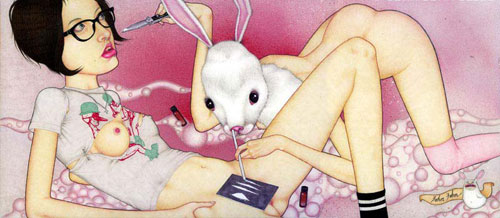
TREVOR BROWN is a sick fuck. There's no doubt about that. A sick fuck with an Asian fetish, if we want to be precise. And yet we haven't even begun to scratch the surface. The toilet bowl inside this artist's brain is overflowing with blood culled from a massive fetish orgy starring a horde of underage Japanese goth sluts for whom the more freakish, unimaginable terrain of human behaviour is the norm, Bondage is a big theme here, as are wounds, lacerations, and bruises - very adult themes depicted in a childlike world of sardonic innocence lost and found. But is it art?
article by travis jeppesen for a prague city magazine / what's-on guide, 2005
He designed the cover of John Zorn's album "The Gift" and he is just awesome!
He started his activities as an artist producing acrylic paintings while attending the Medical School of Chiba University, and began to win prizes and held solo shows. After graduation, he continued his artistic activities while working as an ophthalmologist, but in 1990, he switched to working with computer graphics and became Japan's first Heta-Uma (Bad-Good) style computer graphics illustrator. His cheap but pop style which was produced by using a 2D bitmap painting software became popular and was called "Silly CG." He won the MMA Artist Prize in the Multimedia Grand Prix '95, and his work has appeared in high-school textbooks on art.What is in his head?

 15
comments
15
comments